If you’ve ever wondered whether fertilizer is the same as plant food, you’re not alone. Many novice gardeners ask this “stupid question,” but it’s an important one. Understanding the subtle differences can make a big difference for your plant growth, whether you’re tending indoor plants, leafy vegetables, or a vegetable garden outdoors.
This guide explains what plant food and plant fertilizer are, their differences, sources, types, and how to balance both for optimal growth.
What Is Plant Food?
Plant food is what plants create for themselves using light energy, carbon dioxide, and water. Through photosynthesis, plants convert these elements into carbohydrates, which fuel overall growth.
In other words, plants produce their own food. They use this food to grow roots, stems, leaves, and flowers. Essential nutrients from the soil, like nitrogen, phosphorus, and potassium, help plants make better use of this energy. Without these nutrients, plants may grow slowly, develop yellow leaves, or fail to flower.
Good news: healthy soil provides some nutrients naturally, but sometimes plants need additional nutrients to thrive, especially in sandy soils or clay soils.
What Is Plant Fertilizer?
Plant fertilizer is a commercial product designed to supply plants with nutrients they cannot make themselves. Fertilizers contain primary nutrients such as nitrogen (N), phosphorus (P), and potassium (K), and often trace elements in smaller amounts.
Fertilizers come in various forms, including granular fertilizers, liquid fertilizers, slow-release forms, and even animal manures. They can be synthetic fertilizers from chemical elements or organic plant foods derived from natural sources.
The main purpose of fertilizers is to provide available nutrients to the soil or plant roots. Fertilizer labels indicate an N-P-K ratio, which tells you the concentration of primary nutrients in that product.
What Are the Differences Between Plant Food and Fertilizer?
While both help plant growth, plant food and fertilizer are not the same.
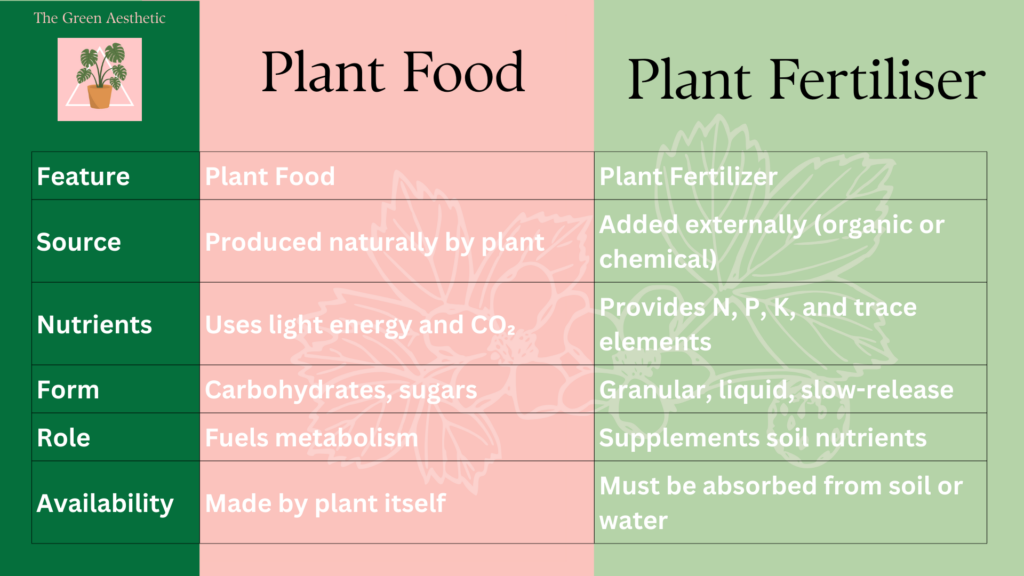
The subtle differences between these two concepts explain why using fertilizer does not replace healthy soil or photosynthesis. Fertilizer is a tool to supply nutrients your plants cannot produce.
Sources of Nutrients
Plants require nutrients from both natural sources and fertilizers.
- Natural organic matter: Compost, animal manures, leaf litter.
- Inorganic fertilizers: Mineral fertilizers, chemical fertilizers, bone meal.
- Water-soluble nutrients: Liquid fertilizers or liquid plant food for rapid growth.
Soil nutrients vary based on soil structure and weather conditions. A soil test can help identify specific nutrient deficiencies before adding much fertilizer.
Composition of Plant Fertilizer
Fertilizers contain essential nutrients in various proportions, depending on the plant type and growth stage.
- Primary nutrients: Nitrogen (N) for leaves, phosphorus (P) for roots, potassium (K) for overall growth.
- Secondary nutrients: Calcium, magnesium, sulfur.
- Trace elements: Iron, manganese, zinc, copper, boron, molybdenum.
The nutrient levels on fertilizer labels help gardeners choose the best type for leafy vegetables, vegetable plants, or ornamental plants.
Types of Plant Food
Plant food can be classified based on its source or function:
- Natural plant food – Created by the plant itself via photosynthesis.
- Organic plant foods – Derived from compost, kitchen waste, or animal manures.
- Liquid feeds – Often applied as liquid plant food to supply nutrients quickly.
Each type plays a crucial role in supporting healthy growth and strong plant roots.
Types of Plant Fertilizer
Plant fertilizers also vary widely.
- Granular fertilizers: Slow-release, applied to the soil surface or mixed into potting soil.
- Liquid fertilizers: Provide nutrients in liquid form for rapid absorption.
- Slow-release fertilizers: Feed plants over a longer period of time.
- Synthetic fertilizers: Inorganic materials designed for rapid growth or correcting nutrient deficiencies.
- Organic fertilizers: Bone meal, compost, and animal manures add natural organic matter while improving soil structure.
Balancing Both for Optimal Growth
For the best results, combine healthy soil, plant food, and fertilizer.
- Use smaller amounts of fertilizer based on soil tests.
- Apply liquid feeds during the growing season for extra nutrients.
- Add granular plant foods for long-term nutrient supply.
- Avoid adding much fertilizer at once, which can harm plant roots and cause water pollution.
Balancing both ensures that plants get essential nutrients, maintain healthy soil, and achieve overall growth without over-reliance on chemical fertilizers. Sustainable gardening practices are crucial for avoiding negative environmental impact.
Other Considerations
- Weather conditions affect nutrient availability, especially in sandy soils or clay soils.
- Hydroponic systems may need only liquid fertilizers because plants rely on nutrient solutions instead of soil.
- Different plants have unique nutrient needs. Leafy vegetables may need more nitrogen, while root crops require phosphorus.
- Regular soil testing is the best choice to ensure correct nutrient levels.
Whether you garden in St. Helena, St. Barthélemy, Costa Rica, or the Cayman Islands, understanding plant food and fertilizer ensures plants thrive in any climate or soil type.
FAQ: Is Fertilizer Plant Food?
1. Is fertilizer the same as plant food?
Not exactly. Plant food is made by the plant itself, while fertilizer provides nutrients externally.
2. Why do plants need fertilizer if they make their own food?
Plants need extra nutrients like nitrogen, phosphorus, and potassium for healthy growth that sunlight alone can’t provide.
3. Can I use too much fertilizer?
Yes. Much fertilizer can harm roots, cause nutrient imbalance, and lead to water pollution.
4. What type of fertilizer is best for leafy vegetables?
Fertilizers high in nitrogen, either liquid or granular, support rapid growth and vibrant leaves.
5. Are organic plant foods better than synthetic fertilizers?
Both are effective. Organic fertilizers improve soil structure, while synthetic fertilizers provide rapid growth.
6. How often should I fertilize my plants?
Apply smaller amounts throughout the growing season, adjusting for plant type and soil nutrient levels.
7. Can fertilizer replace healthy soil?
No. Fertilizer supplements nutrients but does not replace healthy soil, natural organic matter, or photosynthesis.
8. What about hydroponic systems?
Plants in hydroponics rely entirely on nutrient solutions, usually in liquid form, instead of soil nutrients.
Final Thoughts
So, is fertilizer plant food? The answer is both yes and no. Plants produce their own food, but fertilizers supply extra nutrients needed for healthy growth. Understanding the differences, sources, types, and proper use helps your plants thrive in any soil, potting mix, or hydroponic system.
By balancing plant food, natural organic matter, and fertilizer, gardeners—from the Cayman Islands to the French Guiana—can achieve overall growth, healthy soil, and strong plant roots. Next time you visit the big box store, remember: fertilizer is a tool, not a replacement for the plant’s own food.